

A bacterial smear is the thin layer of bacterial cells that is placed on a clean glass slide for microscopic staining. It is the process in which bacteria from a culture is spread gently so that a uniform film is obtained. It is required because living bacterial cells are almost colorless, and staining is not possible unless the cells are first fixed on the slide. It is the preliminary step before Gram staining and other staining methods, and it helps in observing the shape, size, and arrangement of bacteria in stained preparations.
The smear must be thin so that the cells can be seen clearly, and it is usually prepared in such a way that printed letters can be read through the slide. After spreading, the smear is allowed to air-dry completely and then it is fixed by heat or chemicals.
Fixation kills the organisms, helps in adhering the cells to the slide, and prevents the cells from washing away during the staining steps.
Bacterial smear purpose
The main purpose of bacterial smear preparation is to fix the bacterial cell on the slide and prevent the loss of bacterial cells during the staining procedure.
Bacterial Smear Preparation Principle
The principle of bacterial smear preparation is based on forming a thin and uniform layer of cells on the slide so that staining reactions can occur properly. It is the process that ensures the bacteria is fixed on the slide surface, and it is important because living cells are almost colorless under the microscope. It is the principle that the smear must allow the stain to enter the cell and also be able to withstand the washing steps during staining.
In this process, fixation is applied either by gentle heating or by using chemicals like methanol, and it is the step where the cells are killed and the enzymes are inactivated which prevents autolysis. It is also the step by which the bacterial cells are attached firmly to the slide so they do not get removed during staining.
The smear must also follow the principle of proper density, where a thin layer is required so that each cell is exposed to the stain equally. It is said that the smear is correct when it is thin enough that printed letters can be seen through the slide, and this helps in getting uniform results especially in differential staining where thick smears may retain the stain and give wrong observations.
Bacterial Smear Preparation Requirements
- A clean microscope glass slide for holding the specimen.
- Paraffin wax used sometimes for marking or fixing the slide position.
- An inoculating loop which is sterilized before transferring the culture.
- A Bunsen burner needed for sterilizing the loop and for heat fixation.
- A young broth culture or bacterial suspension, or a bacterial culture taken from a petri dish which is usually not older than 24 hours for proper smear formation.
Bacterial Smear Preparation Steps
I. Preliminary Steps and Slide Preparation
1. Use of PPE
It is important that basic protective equipment is used. Gloves, laboratory coat and eye protection is worn before starting the procedure.
2. Cleaning of Slide
A clean and grease-free slide is used. It is cleaned properly because dust particles interfere with the smear.
3. Labeling of Slide
The frosted end of the slide is marked with the sample name using pencil or wax marker. A single slide can hold small multiple smears.
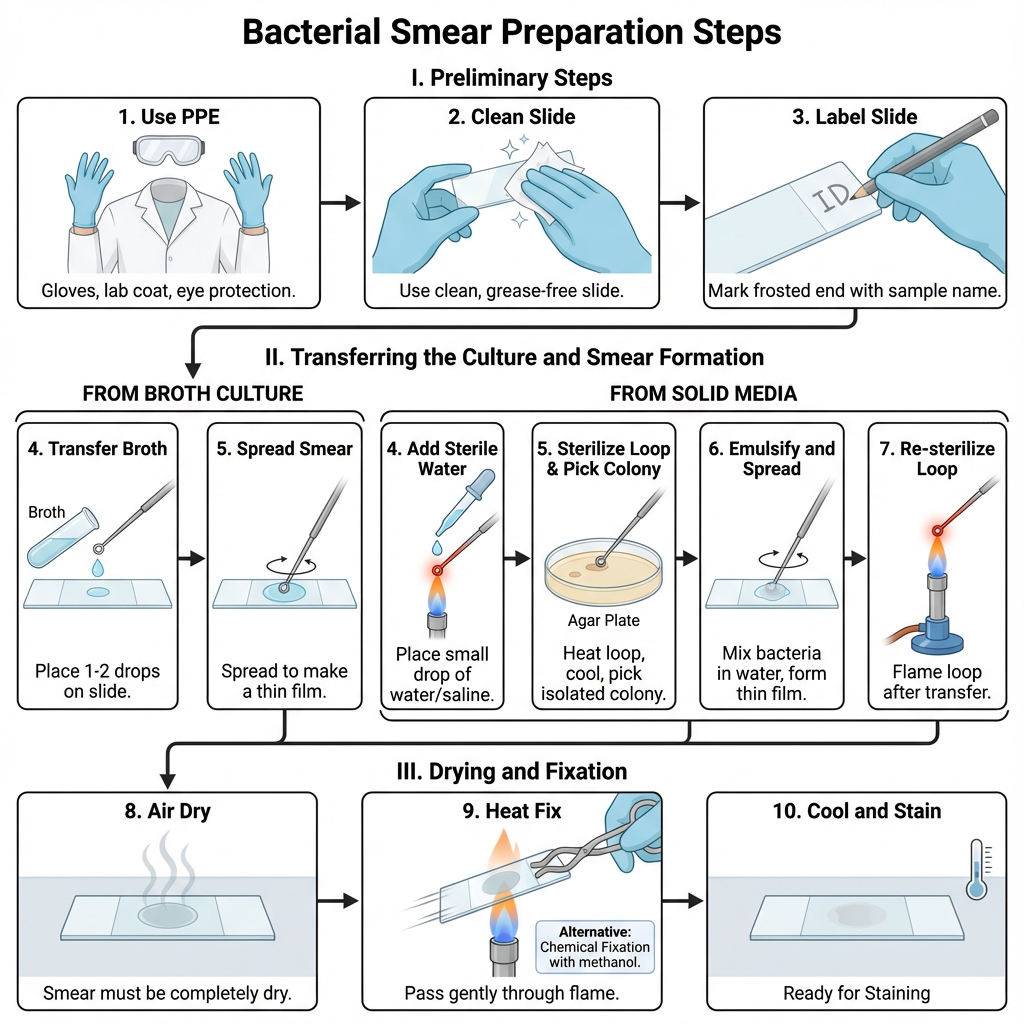
II. Transferring the Culture and Smear Formation
The smear depends on the culture type. It is taken either from broth or from solid media.
A. Preparation from Broth Culture (Liquid Media)
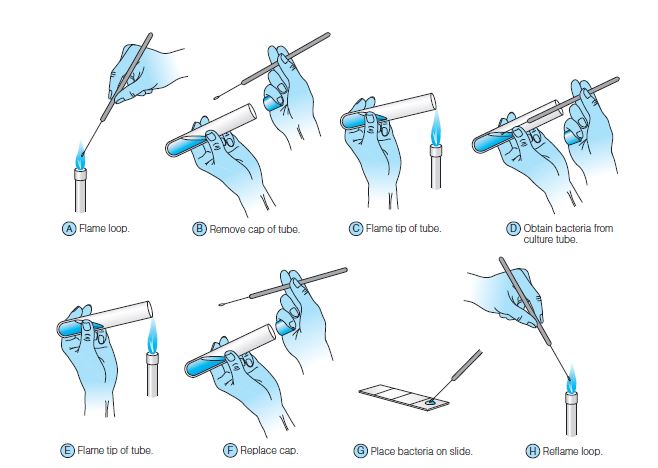
1. Transfer– A sterile loop is taken and 1–2 drops of broth culture is placed on the slide. Water is not required because broth already contains enough liquid.
2. Spreading– In this step the culture drop is spread to make a thin even film. The area is kept small like a round region.
B. Preparation from Solid Media (Agar Plate or Slant)
1. Add Diluent– A small drop of sterile water or saline is placed first. It is the process that helps in emulsifying because solid media is concentrated.
2. Sterilize Loop– The loop is heated until red hot and then cooled.
3. Transfer of Culture– A very small amount of growth is picked from an isolated colony. If the growth on the loop is visible then the smear becomes too thick.
4. Emulsification and Spreading– The bacterial growth is mixed with the water drop in circular motion until it forms a thin film on the slide.
5. Re-sterilization of Loop– After transfer is completed, the loop is flamed again.
III. Drying and Fixation
1. Air Drying– The smear is allowed to air dry completely. Excess moisture causes boiling during fixing which ruptures the cells.
2. Fixation of Smear– Fixation is done either by heat or by chemicals. It helps in attaching the cells to the slide and stopping autolysis.
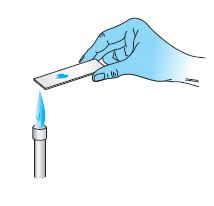
- Heat Fixation– The slide is passed gently over the flame two or three times. It should not be overheated because the cells may get distorted. A slide warmer (at about 65°C) can also be used.
- Chemical Fixation– A few drops of methanol or 95% ethanol is added on the smear and allowed to evaporate naturally.
3. Cooling– The slide is cooled to room temperature before applying the stain.
General Steps;
- It is important to remember that the slide must be clean and the smear must be thin for proper staining.
- Clean the glass microscope slide with water and dry it well.
- Handle the slide from its edges only and label one side with the culture name and the date of smear preparation.
- Use a marking pencil to draw a circle of about 20 mm diameter on the lower side of the slide.
- For a solid bacterial culture, sterilize the inoculating loop and cool it. Take one loopful of distilled water and place it in the center of the circle, then scrape a small amount of bacterial growth from the petri dish and mix it with the water drop. Spread it gently so that a thin smear is formed which looks like diluted skim milk. Sterilize the loop again.
- For a liquid culture, sterilize the loop and cool it. Shake the culture bottle gently and flame its neck. Take a loopful of the liquid culture and place it directly in the circle and make a smear without adding water. Sterilize the loop again.
- Allow the smear to air dry completely, and do not blow or heat the wet smear.
- After drying, heat fix the smear by passing the slide through the flame 2 to 3 times.
Uses of Bacterial Smear
- It helps in microscopic viewing because the smear, after staining, gives contrast to the colorless bacteria.
- It is used for simple staining to observe the size, shape, and arrangement of bacterial cells.
- It is required for differential staining like Gram stain and acid-fast stain for initial classification of bacteria.
- Fixation of the smear helps in keeping the cells attached to the slide and also makes the specimen safe to handle.
- It can be used in some advanced analytical methods where fixed material is required for further study.
Advantages of Bacterial Smear
- It helps in making the bacteria clearly visible because staining gives contrast between the cells and the background.
- It allows simple staining and differential staining to be done for observing morphology and for classification.
- Fixation helps in attaching the cells firmly to the slide so they do not wash off during staining.
- Fixation also kills the microorganisms which makes handling safer and prevents autolysis.
- A thin and uniform smear improves stain penetration and gives correct staining reactions for proper observation.
Limitations of Bacterial Smear
- Thick smears give wrong staining results because the cells in the centre do not get proper action of reagents.
- The smear may wash off if fixation is not done properly or if the smear is too thick.
- Overheating during fixation can damage the cells and distort their shape.
- Gram-variable organisms may show mixed staining especially when the culture is old.
- Dirty or greasy slides cause uneven spreading and may form clumps that affect staining.
FAQ
What is a bacterial smear?
A bacterial smear is the thin film of bacterial cells that is spread on a clean glass slide so that the cells can be fixed and stained for microscopic observation.
How do you prepare a bacterial smear?
It is prepared by placing a small amount of culture in the centre of a marked circle on the slide, spreading it into a thin layer, allowing it to air dry, and then fixing it gently by heat.
What is the purpose of a bacterial smear?
It is the process used to make the bacteria visible after staining and to observe their shape, size, and arrangement under the microscope.
What materials are needed to prepare a bacterial smear?
A clean glass slide, an inoculating loop, paraffin wax for marking, a Bunsen burner, and a fresh bacterial culture are commonly required.
How do you make a bacterial smear from a broth culture?
The loop is sterilized and cooled, then a loopful of the liquid culture is transferred into the centre of the circle on the slide and spread to form a thin smear before drying and fixing.
How do you make a bacterial smear from a solid culture (agar)?
A drop of distilled water is placed on the slide, then a small amount of bacterial growth from the agar plate is mixed in the drop and spread to form a thin smear. After drying, it is heat fixed.
Why is heat fixing important in bacterial smear preparation?
It is important because it kills the cells, inactivates enzymes, and makes the bacteria stick firmly to the slide so they do not wash off during staining.
What are common mistakes when making a bacterial smear?
Using a thick smear, overheating during fixation, not fixing the smear properly, using dirty slides, and taking too much culture are common mistakes.
Why is it important to air dry a bacterial smear completely?
It must be air dried because wet smears may boil or burst during heat fixation, damaging the cells and causing poor staining.
What is the role of a bacterial smear in Gram staining?
The smear provides the thin layer of cells required for applying the primary stain, mordant, decolorizer, and counterstain so that Gram-positive and Gram-negative cells can be differentiated.
How does a bacterial smear help in microscopic examination?
It spreads the cells in a thin layer which allows the stain to enter properly and makes the bacteria clearly visible with their morphology.
What happens if a bacterial smear is too thick?
A thick smear prevents proper staining, may trap the stain, and can give false results, especially in Gram staining where Gram-negative cells may appear Gram-positive.
Can multiple bacterial smears be prepared on one slide?
Yes, more than one smear can be prepared on a single slide if separate circles are drawn and enough space is maintained between them.
What happens if a bacterial smear is over-fixed or under-fixed?
Over-fixing can distort the cells due to excessive heating, while under-fixing may cause the smear to wash off during staining.
What are the applications of bacterial smears in microbiology?
They are used for simple staining, differential staining like Gram staining, observing morphology, identifying bacteria, and preparing samples safely for laboratory examination.
- BYJU’S. (n.d.). Difference between Simple and Differential Staining.
- Cazares, L. H., Van Tongeren, S. A., Costantino, J., Kenny, T., Garza, N. L., Donnelly, G., Lane, D., Panchal, R. G., & Bavari, S. (2015). Heat fixation inactivates viral and bacterial pathogens and is compatible with downstream MALDI mass spectrometry tissue imaging. BMC Microbiology, 15(1), 101. https://doi.org/10.1186/s12866-015-0431-7
- CellaVision. (2022). What are the main problems you encounter when Gram staining?
- Centers for Disease Control and Prevention, Division of Laboratory Systems. (n.d.). Smear preparation.
- Fixation (histology). (n.d.). In Wikipedia. Retrieved from the source material provided.
- Jones & Bartlett Learning. (n.d.). Preparation of a Bacterial Smear and the Simple Stain Technique.
- Petersen, J., & McLaughlin, S. (2021). 4.3: Lab Procedures- Bacterial Smear, Simple and Gram Staining. In A. Lee (Ed.), MB352 General Microbiology Laboratory 2021 (p. 52241). LibreTexts.
- Tripathi, N., Zubair, M., & Sapra, A. (2025). Gram Staining. StatPearls [Internet]. StatPearls Publishing. Retrieved from NCBI Bookshelf.
- Virtual Microbiology. (n.d.). 3-6 Preparation of a Bacterial Smear for Staining. (196694 Reads).