

What is Germ Theory of Disease?
Germ theory of disease is a scientific theory. It states that many infectious diseases are caused due to invasion of host organism by microscopic pathogens (germs). These germs are not seen by naked eye.
These pathogens includes bacteria, viruses, fungi and protozoa. The germs enters in body and then infection is produced. This is referred to as infectious disease transmission by microbes.
It was pioneered in late 19th century by Louis Pasteur and Robert Koch. It was proved by experiments that specific microbes from environment was responsible for causing illness and decay. It was also shown that microbes are not generated spontaneously from non-living matter.
The acceptance of germ theory revolutionized modern medicine and public health. Older belief like miasma theory was replaced. In miasma theory diseases was blamed on bad air (foul smelling air) coming from rotting organic matter.
Key principles of the germ theory of disease
Microorganisms cause disease. Specific infectious diseases are caused by microscopic organisms (pathogens or germs). These includes bacteria, viruses, fungi, prions and protozoa.
External invasion occurs. The disease causing germs are not generated spontaneously within body. It is invaded from outside environment.
Host–pathogen interaction is present. Illness is produced due to biological interaction between microbe and host. It is mainly driven by growth and reproduction of pathogen inside host body.
Transmission occurs from one individual to another. It is spread by direct physical contact or indirect contact. It is also spread by airborne particles, vectors (insects) and contaminated food and water.
Specificity is present. Particular microorganism are responsible for unique condition and specific disease.
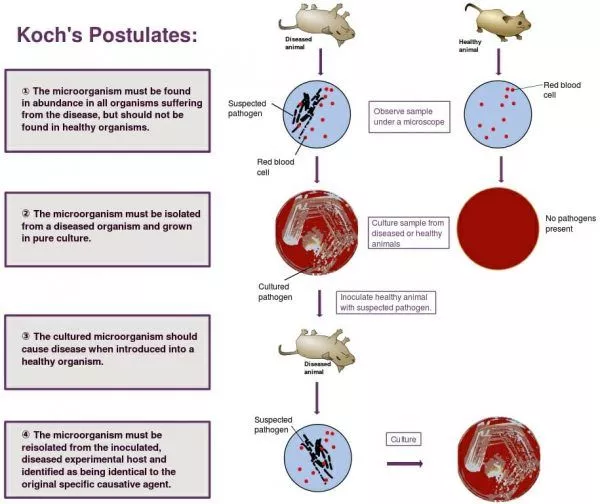
Koch’s postulates (standard of proof) are followed. It is the biological proof connecting specific germ to specific disease. The criteria are as follows–
- The suspected microorganism must be present in all diseased individuals and absent in healthy individuals.
- The microorganism must be isolated from diseased host and cultivated in pure culture in laboratory.
- The cultured microorganism must cause same disease when introduced into healthy susceptible host.
- The microorganism must be re-isolated from newly infected host and it is identified as identical to original causative agent.
Germ theory of disease definition
The Germ Theory of Disease posits that specific diseases are caused by the invasion of the body by microorganisms, often invisible to the naked eye, which proliferate and cause illness. These microorganisms include bacteria, viruses, fungi, and protists.
Who proposed the germ theory of disease? – Who discovered germ theory of disease?
- Germ theory of disease was proposed by Louis Pasteur. It was formally proposed in 1878.
- Germ theory of disease was discovered mainly by Louis Pasteur and Robert Koch. They are considered as founders of germ theory.
- Robert Koch provided the proof in 1876. He demonstrated that a specific bacterium (Bacillus anthracis) causes a specific disease (anthrax). Koch’s postulates was formulated to prove the direct link between microorganism and disease.
- Girolamo Fracastoro laid the early foundation (1546). He proposed invisible “seeds of disease” and it was transmitted by direct contact contaminated objects or air.
- Athanasius Kircher observed plague blood by early microscope (1656). He noted “little worms” (animalcules) and infectious disease was attributed to microscopic pathogen in 1658.
- Marcus Antonius von Plenciz expanded concept (1762). He suggested animalcules in soil and air are responsible for specific diseases (but it was rejected at that time).
- Agostino Bassi gave early biological proof (1835–1836). Silkworm disease was shown to be caused and transmitted by fungal spores.
- Ignaz Semmelweis applied principle practically (1847). Handwashing with chlorinated lime water reduced puerperal (childbed) fever mortality.
- John Snow rejected miasma theory (1854). He traced cholera outbreak to contaminated water pump and cholera was suggested to be caused by microscopic cells ingested and replicated in gut.
- Joseph Lister applied germ concept in surgery (1867). Carbolic acid was used as antiseptic to clean wounds and instruments and post-operative infections was reduced.
History of Germ Theory
- Early theories were followed before germ theory. The main belief was miasma theory. It states that disease is caused by bad air coming from decaying matter. Another belief was spontaneous generation. It was believed that living organisms can arise from non-living things.
- In 1546 Girolamo Fracastoro proposed early concept of contagion. Diseases was suggested to be spread by transferable “seeds of disease”. It is transmitted by direct contact objects or air.
- In 1670s Antonie van Leeuwenhoek invented single lens microscope. Microorganisms was observed directly and it was named as “animalcules”.
- In 1847 Ignaz Semmelweis noticed disease transfer by human contact in maternity wards. Handwashing with chlorinated lime water was pioneered. Mortality rate was reduced drastically.
- In 1854 John Snow investigated cholera outbreak in London. It was traced to contaminated water pump. Miasma theory was rejected and it was proved that disease was swallowed not inhaled.
- In 1850s–1860s Louis Pasteur discovered microorganisms causes fermentation and food spoilage. Pasteurization was invented. Spontaneous generation was disproved by swan-necked flask experiment and it was proved that microbes came from environment.
- In 1867 Joseph Lister introduced antiseptic surgery. Carbolic acid was used to clean wounds and surgical instruments. Postoperative infections was reduced.
- In 1876–1884 Robert Koch proved that specific bacteria causes specific diseases. Anthrax tuberculosis and cholera was proved. Koch’s postulates was published and it is a four step criteria to establish causal relationship between microbe and disease.
- In 1878 Louis Pasteur formally proposed germ theory of disease. It was presented in front of French Academy of Medicine.
- In late 19th and 20th century germ theory was accepted widely. It became foundation of modern public health sanitation antibiotics and vaccines. Mortality rates was reduced and life expectancy was increased.
What was the Miasma theory?
- Miasma theory is an old medical theory. It was the prevailing belief before discovery of microorganisms. It states that epidemic diseases (cholera bubonic plague malaria) are caused by inhaling miasma. It is a noxious form of bad air or night air.
- The source of miasma was believed to be poisonous vapour or mist. It contains particles from rotting organic matter decaying corpses swamps garbage and sewage.
- Detection was done by smell. It was associated with filth and decay so it was identified by foul odour.
- Mode of transmission was explained as air borne. Diseases was not considered contagious (not passed directly person to person). Anyone in a specific location was affected if polluted air is breathed in.
- Historical origin is from ancient Greece. It was advanced by Hippocrates (fifth century BC). It was expanded by Galen. It remained dominant explanation through Middle Ages and into 19th century.
- Impact on public health was seen. Although reasoning was incorrect it led to hygiene and sanitation reforms. Streets were cleaned sewer systems were built waste was managed and hospitals were ventilated to remove bad odours (all smell is disease).
- Decline and replacement occurred in second half of 19th century. It was challenged and disproved. It was replaced by germ theory of disease. Germ theory proved that specific microscopic pathogens (germs) causes illness by work of John Snow Louis Pasteur and Robert Koch.
The Establishment of Germ Theory of Disease
- Establishment of germ theory of disease was a gradual process. It replaced older beliefs like spontaneous generation (life arises from non-living matter) and miasma theory (disease is caused by bad air from decaying matter).
- Francesco Redi (1668) gave early experimental evidence against spontaneous generation. Maggots was shown to appear only on meat left uncovered and exposed to flies.
- Antonie van Leeuwenhoek (1670s) invented single-lens microscope. Microorganisms was observed directly and described. It was called as “animalcules”.
- Ignaz Semmelweis (1847) noticed maternal death rate dropped when doctors washed hands with chlorinated solution. It was demonstrated that unseen agents are transferred by human contact.
- John Snow (1854) rejected miasma theory. Cholera outbreak in London was traced to contaminated public water pump. It was proved that disease was ingested not inhaled.
- Louis Pasteur (1850s–1880s) is considered primary founder of germ theory. Microorganisms was proved to be responsible for fermentation and souring of wine and milk. Pasteurization (heating liquids to kill pathogens) was invented.
- Spontaneous generation was disproved by swan-necked flask experiment. It was proved that microbes do not appear spontaneously but it comes from particles in air.
- Germ theory of disease was formally proposed to French Academy of Medicine in 1878. Vaccines for anthrax and rabies was developed.
- Joseph Lister (1867) applied Pasteur findings in medicine. Carbolic acid was introduced as antiseptic to clean wounds surgical instruments and air. Postoperative infections was reduced drastically.
- Robert Koch (1870s–1880s) provided definitive biological proof. He proved Bacillus anthracis causes anthrax and it linked specific organism with specific disease.
- Bacteria responsible for tuberculosis and cholera was isolated. Koch’s postulates was established as four step scientific method to prove microorganism is cause of disease.
- Laboratory techniques was pioneered. Pure bacterial culture was grown on solid media (agar). Staining with dyes was used for better microscopic observation.
Applications and Importance of the Germ Theory of Disease
- Germ theory of disease is important in medicine. It caused a paradigm shift. Older concepts like miasma theory (bad air) and spontaneous generation was replaced. It was proved that specific microscopic pathogens causes specific diseases.
- Antiseptic and aseptic surgery was developed. It inspired Joseph Lister to use carbolic acid to sterilize wounds hands and surgical instruments. Surgical practice was transformed and fatal postoperative infections was reduced.
- Vaccines development was supported. It was understood that specific microbes causes disease so pathogens was isolated and weakened. Vaccines for anthrax and rabies was developed by Louis Pasteur.
- Discovery of antibiotics was supported. Germ theory laid foundation for targeted chemical therapy. Paul Ehrlich “magic bullets” for syphilis was developed and later Alexander Fleming discovered penicillin. Fatal bacterial infections became treatable.
- Public health and sanitation reforms was done. Focus was shifted to destroying and avoiding germs. Clean water supply sewage system and food safety regulation like pasteurization was improved.
- New scientific disciplines was established. Medicine was made as rigorous science. Fields like microbiology bacteriology and immunology was developed.
- Life expectancy was increased. Infectious disease mortality was reduced due to sanitation vaccines and antibiotics. It was reduced from 30% of all deaths in late 19th century to 4% after one century and global life expectancy increased from about 30 years to over 70 years.
Key Figures in the Development of Germ Theory
- Girolamo Fracastoro (1476–1553). He proposed “seeds of disease”. It was suggested that infection is spread by direct contact indirect contact with contaminated objects (fomites) or by particles in air.
- Athanasius Kircher (1602–1680). He used early microscope to examine blood of plague victims. “Little worms” (animalcules) was noted. Infectious diseases was attributed to microscopic pathogens.
- Francesco Redi (1626–1697). Experimental evidence was given against spontaneous generation (life arises from non-living matter). Maggots was shown to appear only when meat is left uncovered and exposed to flies.
- Antonie van Leeuwenhoek (1632–1723). Single-lens microscope was created. Microorganisms was observed and described. It was called as “animalcules”.
- Marcus Antonius von Plenciz (1705–1786). Theory of contagion was published. It was argued that specific animalcules in soil and air are responsible for specific diseases.
- Agostino Bassi (1773–1856). Silkworm disease was discovered to be caused and transmitted by fungal spores. Rapid disinfection and removal of diseased caterpillars was recommended.
- Ignaz Semmelweis (1818–1865). Puerperal (childbed) fever was deduced as contagious disease. It was spread by doctors coming from morgue autopsies to maternity wards. Handwashing with chlorinated lime water was mandated and maternal mortality was reduced drastically.
- John Snow (1813–1858). Miasma (bad air) theory was rejected. In 1854 cholera epidemic in London was traced to contaminated water pump on Broad Street. Cholera transmission was proved through fecal-oral route.
- Louis Pasteur (1822–1895). Germ theory was formally proposed to French Academy of Medicine in 1878. Spontaneous generation was disproved by swan-necked flask experiment. Fermentation and spoilage was proved to be caused by microorganisms. Vaccines for anthrax and rabies was developed.
- Joseph Lister (1827–1912). Pasteur findings was applied in surgery. Carbolic acid was introduced to sterilize wounds hands and surgical instruments. Fatal postoperative infections was decreased.
- Robert Koch (1843–1910). Definitive proof was given that specific microbes causes specific diseases. Bacteria responsible for anthrax tuberculosis and cholera was identified. Koch’s postulates was established as four-step scientific criteria to determine causal relationship between microbe and disease.
Experiments that support the germ theory of disease
Experiments that support germ theory of disease are the scientific proofs. It was used to show that microorganisms (germs) are responsible for disease and decay. It also disproved spontaneous generation and miasma theory.
Experiments and interventions are as follows–
- Francesco Redi meat and maggots experiment (1668). Meat was placed in different jars. Some jars was kept open and some was covered with gauze. Maggots was formed only in meat exposed to flies. It gave evidence against spontaneous generation (life arises from non-living matter).
- Agostino Bassi silkworm observation (1835–1836). A disease affecting silkworm was studied. It was proved that illness is transmitted between individuals by fungal spores. It is an early biological proof of contagion.
- Ignaz Semmelweis handwashing intervention (1847). Maternal death rate from puerperal fever was found highest when doctors examined women after autopsies. Handwashing with chlorinated lime water was made mandatory. Mortality rate dropped drastically. It proved that unseen infectious matter was transferred from corpse to patient.
- John Snow cholera mapping (1854). Cholera outbreak in London was studied by statistical mapping. Infections was traced to contaminated water pump on Broad Street. People drinking cleaner upstream water was less likely to die. It proved cholera is transmitted by ingested microscopic cells in water not by inhaled bad air.
- Louis Pasteur fermentation studies (1857). Souring of wine and beer was investigated. Spoilage was shown to be caused by living microorganisms contaminating liquids from environment. Mild heating (pasteurization) killed germs and souring was prevented.
- Louis Pasteur swan-necked flask experiment (1860s). Nutrient broth was boiled in flasks with curved S-shaped neck. Air was allowed to enter but dust and airborne microbes was trapped in curve. Broth remained clear and sterile. When flask was tilted and broth touched trapped dust then contamination occurred. It proved decay comes from airborne microbes not from air itself and spontaneous generation was disproved.
- Joseph Lister antiseptic surgery (1867). Postoperative infections was hypothesized to be caused by airborne germs. Carbolic acid (phenol) was applied on wounds instruments and surgeon hands. Antiseptic barrier was formed and surgical mortality was decreased.
- Robert Koch anthrax experiment (1876). Blood of cows died of anthrax was examined. Rod-shaped bacteria was identified. Bacteria was grown in pure culture and injected into healthy mice. Mice contracted anthrax. It proved that specific microscopic organism causes specific disease.
- Louis Pasteur anthrax vaccine trial (1881). Anthrax bacillus was weakened (attenuated) by chemical heating. It was injected into sheep and cows and control group was left unvaccinated. Later both groups was injected with live virulent anthrax. Vaccinated animals lived and unvaccinated animals died. It established link between specific germ and immune resistance.
FAQ
What is the germ theory of disease?
The germ theory of disease is the scientific theory that states that diseases are primarily caused by microorganisms, such as bacteria, viruses, fungi, and parasites.
What is spontaneous generation?
Spontaneous generation was an outdated theory that suggested living organisms could arise spontaneously from non-living matter. It proposed that organisms, including microorganisms, could generate on their own without the need for pre-existing life.
Who proposed the theory of spontaneous generation?
The theory of spontaneous generation was first suggested by ancient Greek philosophers and later elaborated upon by scientists such as Aristotle. However, it was ultimately disproven by the experiments of Louis Pasteur.
How did Louis Pasteur disprove spontaneous generation?
Louis Pasteur conducted experiments in the 19th century using swan-necked flasks filled with broth. He demonstrated that when the broth was exposed to the air, microbial growth occurred, but when the flask remained sealed, no growth occurred. This experiment conclusively showed that microorganisms did not spontaneously generate but instead came from external sources.
What were the implications of Pasteur’s experiments?
Pasteur’s experiments provided strong evidence in support of the germ theory of disease. They showed that microorganisms, rather than spontaneous generation, were responsible for the contamination of substances and the spread of disease.
How did the rejection of spontaneous generation impact medicine?
The rejection of spontaneous generation led to a paradigm shift in medicine. It prompted the understanding that diseases were caused by specific microorganisms and could be prevented or treated by targeting these pathogens. This led to advancements in hygiene practices, sterilization techniques, and the development of vaccines.
What are the key principles of the germ theory of disease?
The germ theory of disease is based on the following principles:
Diseases are caused by specific microorganisms.
Microorganisms can be transmitted from person to person or through other means.
Microorganisms can be isolated and grown in culture.
Interventions that target microorganisms can prevent or treat diseases.
How did the acceptance of the germ theory of disease impact public health?
The acceptance of the germ theory of disease revolutionized public health practices. It led to the implementation of measures such as sanitation, sterilization of medical instruments, vaccination programs, and the development of antibiotics, all of which significantly reduced the spread and impact of infectious diseases.
Are there any remaining controversies or challenges related to the germ theory of disease?
While the germ theory of disease is widely accepted, there are still ongoing challenges and controversies in microbiology and infectious disease research. These include emerging infectious diseases, antibiotic resistance, and the discovery of new pathogens.
How does the germ theory of disease continue to influence medical research and practice today?
The germ theory of disease remains a foundational concept in medical research and practice. It guides the development of new treatments, vaccines, and antimicrobial strategies. It also informs infection control practices in healthcare settings and the understanding of host-microbe interactions.
References
- Adler, R. (2023). Pasteur Begins Developing Germ Theory and Microbiology. EBSCO Research Starters.
- Ciulla-Bohling, R. (2024). Koch’s postulates. EBSCO Research Starters.
- Davenport, R. (2020). Patterns of death, 1800–2020: Global rates and causes. In P. N. Stearns (Ed.), The Routledge History of Death since 1800 (pp. 21–44). Routledge.
- Halliday, S. (2001). Death and miasma in Victorian London: an obstinate belief. BMJ, 323(7327), 1469–1471.
- Horgan, J. (2023, July 24). Germ Theory. World History Encyclopedia.
- Jambholkar, P. C., Choudhari, S. G., & Sharma, M. (2024). Louis Pasteur: A Legacy Unmasked. Cureus, 16(8), e68080.
- Kannadan, A. (2018). History of the Miasma Theory of Disease. ESSAI, 16(1), Article 18.
- Karamanou, M., Panayiotakopoulos, G., Tsoucalas, G., Kousoulis, A. A., & Androutsos, G. (2012). From miasmas to germs: a historical approach to theories of infectious disease transmission. Infezioni in Medicina, 20(1), 58–62.
- Lanziner, J. (2020, May 30). Discovering Diseases: The Beginnings of Germ Theory and Preventative Precautions. Canadian Museum of Health Care.
- Liddell, C., & Hartsock, A. (n.d.). Germ Theory of Disease | Definition & Effects. Study.com.
- Liu, Y., Chang, S., Murphy, G., Ajayi-Akinsulire, E., Ardren, I., Guy, I., Johnston, K., Lee, S., & Russell, L. (2025). 16.3: Koch Postulate and Molecular Koch Postulate. Biology LibreTexts.
- Miller, S. P. (2024). Germ theory of disease. EBSCO Research Starters.
- National Research Council (US) Committee to Update Science, Medicine, and Animals. (2004). A Theory of Germs. In Science, Medicine, and Animals. National Academies Press.
- Newcastle University. (n.d.). Germ Theory. Health and the People.
- Shaw-Taylor, L. (2020). An introduction to the history of infectious diseases, epidemics and the early phases of the long‐run decline in mortality. Economic History Review, 73(3), E1–E19.
- Vaia Editorial Team. (2024, December 5). Miasma theory. Vaia.
- Wikipedia contributors. (2025, December 26). Germ theory of disease. In Wikipedia, The Free Encyclopedia.
- Wikipedia contributors. (2026, February 12). Miasma theory. In Wikipedia, The Free Encyclopedia.