

Kligler’s Iron Agar (KIA) is a special solid culture medium which is used in microbiology to grow and differentiate bacteria. It is prepared in a test tube and it is allowed to solidify in slant position, so two region is formed. The upper part is called slant and it is oxygen rich. The lower deep part is called butt and it is oxygen depleted.
It is a nutrient medium containing peptones(protein digests) phenol red(pH indicator) sulfur compounds iron salts and two fermentable sugars. Glucose is present in low concentration (0.1%) and lactose is present in high concentration (1.0%). This composition is used to observe different metabolic activity in single tube.
Kligler’s Iron Agar test is a biochemical test which is used to identify and differentiate Gram-negative enteric bacilli mainly members of Enterobacteriaceae. It is used for organisms like Salmonella Shigella etc. This test is used to detect glucose fermentation lactose fermentation gas production and hydrogen sulfide(H2S) production in same tube.
In this test a pure culture is taken by sterile inoculating needle and inoculation is done by stabbing straight down into butt region and then streaking over slant surface. The tube is incubated for 18 to 24 hours and cap is kept loosened for oxygen exchange.
After incubation result is observed by color change and physical change in KIA tube. Phenol red is used as indicator which turns yellow in acidic condition and red in alkaline condition. If glucose and lactose both are fermented then acid is produced in high amount and slant and butt both becomes yellow. If only glucose is fermented then glucose is used quickly and on slant peptone is utilized so alkaline product is formed and slant becomes red again but butt remains yellow. If no sugar is fermented then peptone is used and both slant and butt remains red.
Gas production is seen by bubbles cracks or lifting of agar. Hydrogen sulfide production is seen when sulfur is reduced and H2S reacts with iron salts and black precipitate is formed in butt.
Purpose of Kligler’s Iron Agar Test
- To identify and differentiate Gram-negative enteric bacilli mainly members of Enterobacteriaceae family.
- To test the organisms ability to ferment glucose lactose or both sugars and produce acid.
- To determine gas production and hydrogen sulfide(H2S) production during metabolism.
- To differentiate lactose fermenters and non lactose fermenters by slant and butt reaction.
Objectives of Kligler’s Iron Agar Test
Kligler’s Iron Agar (KIA) test is based on principle that different bacteria have different ability to ferment sugars and reduce sulfur compounds. The medium contains phenol red(pH indicator) iron salts sulfur compounds glucose(0.1%) and lactose(1.0%). The organisms is inoculated in butt and streaked on slant, so aerobic and anaerobic reaction is observed in same tube.
In this test glucose is first fermented because it is easily fermentable sugar. Acid is produced and pH is reduced so phenol red changes to yellow. Therefore slant and butt both becomes yellow at initial stage. Since glucose is present in low amount it is exhausted quickly.
If lactose is not fermented then bacteria starts using peptone on slant in presence of oxygen. Alkaline byproducts(ammonia) are formed and alkaline reversion occurs. So slant changes back to red but butt remains yellow because butt is anaerobic and acid condition is maintained.
If lactose is fermented then large amount of acid is produced continuously due to high lactose concentration. So slant and butt both remains yellow. If both sugar is not fermented then bacteria depends on peptone utilization and alkaline condition is formed, therefore whole medium remains red.
This test also shows gas production and hydrogen sulfide(H2S) production. Gas is seen as bubbles cracks splitting or displacement of agar. If sulfur compounds are reduced then H2S gas is produced and it reacts with iron salts and black precipitate is formed mainly in butt region.
Requirements
- Kligler’s Iron Agar(KIA) medium prepared in test tubes as slant.
- No extra reagents is required for this test.
- Test tubes incubator autoclave weighing machine Bunsen burner(or incinerator) straight inoculating needle inoculating loop and PPE(gloves lab coat mask).
- Pure bacterial culture of test organism grown on solid media for 18 to 24 hours.
- Control organisms(known strains) for quality control such as Escherichia coli Salmonella Typhimurium Pseudomonas aeruginosa Proteus vulgaris Shigella flexneri.
Composition (per 1000 mL) of Kligler Iron Agar
- Peptone – 15.00 g
- Lactose – 10.00 g
- Agar – 15.00 g
- Proteose peptone – 5.00 g
- Sodium chloride – 5.00 g
- HM peptone B(beef extract) – 3.00 g
- Yeast extract – 3.00 g
- Dextrose(Glucose) – 1.00 g
- Sodium thiosulfate – 0.300 g
- Ferrous sulfate – 0.200 g
- Phenol red – 0.024 g
- Final pH – 7.4 ± 0.2 at 25°C
- Note – slight variation may be present depending on manufacturer. Agar may be 12.0 to 18.0 g. Peptones may be substituted with pancreatic or peptic digests of casein/animal tissue. Ferric ammonium citrate(0.2 to 0.5 g) may be used in place of ferrous sulfate.
Preparation of Kligler Iron Agar
- Required amount of dehydrated KIA medium powder is weighed (about 52.0 to 58.0 g per litre depending on manufacturer).
- The powder is added into 1 litre distilled/deionized/purified water in a flask.
- The suspension is mixed properly and it is heated to boiling with frequent agitation till agar and all components are dissolved completely.
- The prepared liquid medium is dispensed into test tubes (about 5 to 7 mL per tube) and caps/cotton plugs is kept loosened.
- The tubes are sterilized by autoclave at 121°C (15 lbs pressure) for 15 minutes.
- After sterilization tubes are removed and kept in slant position for cooling (around 30°) so slant and butt is formed. Aerobic slant is formed about 2.5 cm and anaerobic butt is formed about 3 to 5 cm deep.
Control organisms
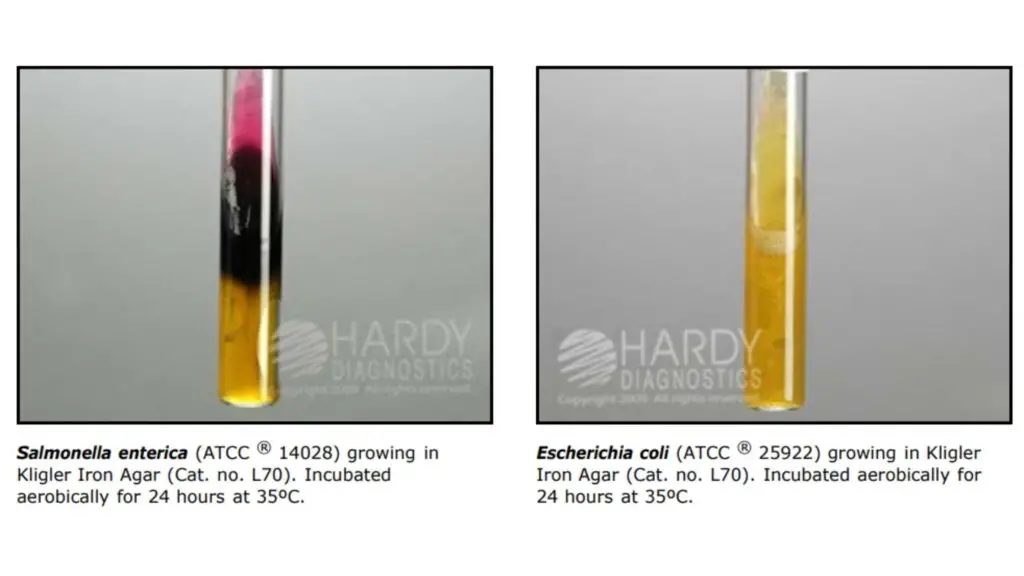
- Escherichia coli(ATCC 25922) – used for acid production (yellow slant/yellow butt) and gas production. H2S is negative.
- Salmonella Typhimurium / Salmonella enterica(ATCC 14028) – used for glucose fermentation (red slant/yellow butt) gas production and H2S production(blackening).
- Pseudomonas aeruginosa(ATCC 27853) – non fermenter control. Red slant/red butt is seen. Gas and H2S is not produced.
- Shigella flexneri(ATCC 12022) – used for glucose fermentation (red slant/yellow butt) without gas and without H2S.
- Citrobacter freundii(ATCC 8090) – used for acid production gas production and positive H2S production.
- Proteus vulgaris(ATCC 6380 or ATCC 13315) – used for positive H2S production and glucose fermentation. Gas is not produced.
- Salmonella Enteritidis(ATCC 13076) – used for glucose fermentation with gas production and positive H2S production.
- Salmonella Paratyphi A(ATCC 9150) – used for glucose fermentation and gas production. H2S is negative.
- Enterobacter cloacae(ATCC 13047) – used for lactose and glucose fermentation with gas production but H2S is negative.
Procedure of Kligler’s Iron Agar Test
- Prepared KIA tubes are taken and it is allowed to come at room temperature before starting the test.
- A pure fresh bacterial culture(18 to 24 hours old) is selected and a well isolated colony is taken. Sterile straight inoculating needle is used for picking the colony. Needle is used instead of loop so that organism is delivered deep into medium and agar is not broken.
- Inoculation is done by stab and streak method. The needle is stabbed straight down through centre of agar into butt region and it is stopped about 3 to 5 mm above the bottom of tube.
- While withdrawing the needle the slant surface is streaked in zigzag/serpentine manner.
- The cap is placed back and it is kept slightly loosened(about half turn) for proper oxygen exchange on slant.
- The tubes are incubated under aerobic condition at 35°C (or 33 to 37°C) for 18 to 24 hours.
- After incubation tubes are observed and result is recorded. Colour of slant and butt is noted. Black precipitate for H2S production is observed. Cracks bubbles or displacement of agar is observed for gas production.
- The result is read within 18 to 24 hours. If it is read before 18 hours or after 24 hours false interpretation may occur due to incomplete fermentation or alkaline reversion.
Results of Kligler’s Iron Agar Test
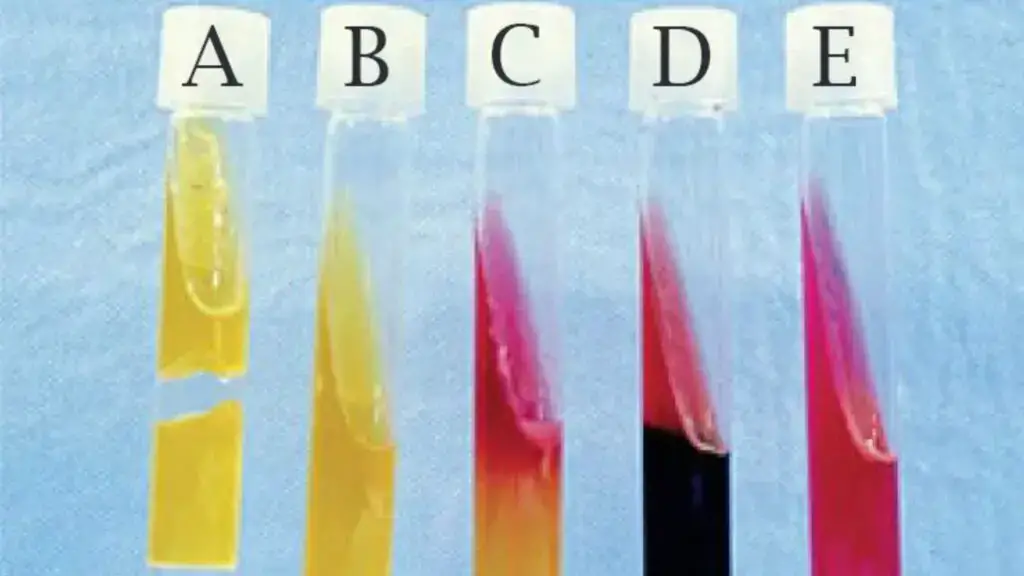
Yellow slant / Yellow butt (A/A) – It indicates glucose and lactose both are fermented. Acid is produced so slant and butt becomes yellow.
Red slant / Yellow butt (K/A) – It indicates only glucose is fermented. Lactose is not fermented so organism is lactose non fermenter. Slant becomes red due to alkaline reversion and butt remains yellow.
Red slant / Red butt (K/K) – It indicates glucose and lactose both are not fermented. Peptone is utilized and alkaline condition is formed so slant and butt both remains red.
Red slant / No change in butt (K/NC) – It indicates peptone is utilized without fermenting sugars. Slant remains alkaline and butt shows no change.
Blackening of medium / black spots or ring – It indicates hydrogen sulfide(H2S) gas is produced. Black precipitate is formed due to reaction of H2S with iron salts. If butt is blackened then butt is considered acidic(A) even if yellow colour is not seen.
Cracks / bubbles / displacement of agar – It indicates gas is produced during carbohydrate fermentation.
List of organisms which gives positive and negative result in KIA Test
Because the Kligler’s Iron Agar (KIA) test evaluates multiple metabolic parameters simultaneously, there is no single “positive” or “negative” result for the entire tube. Instead, organisms are categorized by their specific positive or negative reactions for sugar fermentation, hydrogen sulfide (H2S) production, and gas production:
1. Sugar Fermentation Results
- Positive for Glucose and Lactose Fermentation (Yellow slant / Yellow butt or A/A):
- Escherichia coli
- Klebsiella pneumoniae
- Klebsiella oxytoca
- Enterobacter cloacae
- Positive for Glucose only / Negative for Lactose (Red slant / Yellow butt or K/A):
- Salmonella Typhimurium and Salmonella Enteritidis
- Salmonella Typhi
- Shigella flexneri and other Shigella spp.
- Proteus mirabilis and Proteus vulgaris
- Morganella morganii
- Edwardsiella tarda
- Providencia stuartii
- Negative for both Glucose and Lactose (Red slant / Red butt or K/K):
- Pseudomonas aeruginosa
- Alcaligenes faecalis
2. Hydrogen Sulfide (H2S) Production
- Positive for H2S (Black precipitate in the agar):
- Salmonella Typhimurium and Salmonella Enteritidis
- Salmonella Typhi (often a weak positive, seen as a black ring)
- Proteus mirabilis and Proteus vulgaris
- Citrobacter freundii
- Edwardsiella tarda
- Negative for H2S (No black precipitate):
- Escherichia coli
- Shigella flexneri
- Klebsiella pneumoniae
- Enterobacter cloacae
- Pseudomonas aeruginosa
3. Gas Production
- Positive for Gas (Bubbles, cracks, or displacement of the agar):
- Escherichia coli
- Klebsiella pneumoniae
- Enterobacter cloacae
- Salmonella Typhimurium and Salmonella Enteritidis
- Proteus mirabilis
- Citrobacter freundii
- Edwardsiella tarda
- Negative for Gas (Intact agar):
- Shigella flexneri
- Salmonella Typhi
- Pseudomonas aeruginosa
- Proteus vulgaris
Uses of KIA Test
- It is used for presumptive identification and differentiation of Gram-negative enteric bacilli from clinical and non clinical samples.
- It is used to identify and differentiate Enterobacteriaceae members based on metabolic pattern.
- It is used to determine glucose(dextrose) fermentation lactose fermentation and hydrogen sulfide(H2S) production in same test.
- It is used to differentiate lactose fermenters and non lactose fermenters by slant and butt reaction.
- It is used for screening of fecal(stool) cultures for intestinal pathogens causing typhoid dysentery and related infections.
- It is used to differentiate Salmonella species and Shigella species.
- It is used for sub typing of Salmonella like Salmonella Typhi from other Salmonellae and Salmonella Paratyphi A from Salmonella Schottmuelleri and Salmonella Enteritidis.
- It is also used to detect H2S production in some non enteric bacteria such as certain Pseudomonas strains.
Limitations of KIA Test
- The result is read strictly within 18 to 24 hours. If it is read before 18 hours false negative fermentation may occur and K/A may be seen. If it is read after 24 hours false alkaline shift may occur and K/K may be obtained due to sugar exhaustion and peptone metabolism.
- It is not a confirmatory test. It is presumptive test and it cannot be used alone for final identification. Other biochemical immunological molecular or mass spectrometry tests are required for complete identification.
- Heavy H2S production can mask the yellow colour in butt. Black precipitate may cover the acidic(yellow) reaction and it becomes difficult in reading.
- KIA medium does not contain inhibitors. Many non target organisms can grow on it so it should be inoculated only with pure culture and organism should be confirmed as Gram-negative bacilli.
- It cannot separate some sugar reactions. Yellow slant/yellow butt is seen when glucose and lactose both are fermented and also it is seen when lactose alone is fermented, so differentiation is not possible in these cases.
- The test is sensitive to procedural errors. If butt is not stabbed properly test becomes invalid. If caps are tightly closed oxygen exchange is reduced and alkaline reversion does not occur so false acidic(yellow) slant may be seen.
Precautions of KIA Test
- KIA medium tubes is checked before use. Cracked agar separated agar discoloured medium or contaminated tubes should not be used.
- Pure culture should be used for inoculation. Mixed culture gives irregular result and it becomes difficult for interpretation.
- Straight sterile inoculating needle is used always. Loop should not be used because it can split/break the agar and it may be misinterpreted as gas production.
- Butt should be stabbed properly and deep into anaerobic region. If butt is not stabbed then test is not valid.
- During incubation cap is kept loosened(about half turn). If cap is tight oxygen exchange is restricted and alkaline reversion on slant does not occur so false yellow slant may be seen.
- Result is read within 18 to 24 hours strictly. If it is read before 18 hours lactose fermentation may appear negative. If it is read after 24 hours false non fermenter result may occur due to sugar depletion and excess peptone metabolism.
- If reading is delayed then tubes are removed from incubator and it is kept in refrigerator at 4°C to stop the reaction.
- Blackening is interpreted correctly. Heavy H2S production can make butt fully black and yellow colour is hidden. H2S is produced only in acidic condition so black butt is always considered as acidic(yellow) butt.
References
- Acumedia Manufacturers. (2017, March 30). Kligler iron agar (7140).
- Aryal, S. (2022, August 10). Kligler’s iron agar test – Procedure, uses and interpretation. MicrobiologyInfo.com.
- BD Diagnostics. (n.d.). Kligler iron agar. Difco Manual.
- Biokar Diagnostics. (2018, January). Technical data sheet: Kligler iron agar.
- Biolife Italiana. (2023, April). Instructions for use: Kligler iron agar dehydrated culture medium.
- Comprehensive analytical study of Kligler iron agar in clinical microbiology: Historical evolution, biochemical principles, and diagnostic applications. (n.d.).
- DrChika. (2022, December 28). Triple sugar iron agar (TSIA). Microbiology Class.
- Filo. (2025, October 22). Kligler iron agar (KIA) differs from triple-sugar iron agar (TSI) in the:..
- Hardy Diagnostics. (2020). Instructions for use: CRITERION™ Kligler iron agar (KIA).
- Hardy Diagnostics. (2020). Instructions for use: Kligler iron agar (KIA).
- HiMedia Laboratories. (2018, February). Technical data: Kligler iron agar M078.
- HiMedia Laboratories. (2025, April). Technical data: Kligler iron agar M078I.
- Lehman, D. (2005, September 30). Triple sugar iron agar protocols. American Society for Microbiology.
- MacKenzie, E. (2025, October 14). 31.7: Kligler iron agar (KIA) test. Biology LibreTexts.
- Sigma-Aldrich. (n.d.). Product information: 60787 Kligler agar (Kligler iron agar).
- Sigma-Aldrich. (n.d.). Product information: Kligler iron agar (K2260).
- Thermo Fisher Scientific. (2012, June 19). Kligler iron agar (KIA).
- Watson, R. (n.d.). Summary of biochemical tests. Microbiology Lab: MOLB 2210.
- Wikipedia contributors. (2025, October 4). TSI slant. Wikipedia, The Free Encyclopedia.