

Flagella are filamentous cytoplasmic structure that are projecting out from the cell wall, and it is mainly made of the protein flagellin. It is an unbranched, thread-like structure having about 12–30 nm diameter and 5–16 µm length. These are important for movements, sensation, adhesion and signal transduction in many bacteria. The parts of flagella include the Filament, the Hook and the Basal body, and it is the arrangement of these parts that help in producing different types of motility. Based on distribution, the flagella are classified into Monotrichous (single polar flagellum), Amphitrichous (single flagellum on both sides), Lophotrichous (tufts of flagella at one or both sides) and Peritrichous (numerous flagella all over the bacterial body).
Flagella staining is the process used to study the presence and arrangement of flagella in motile bacteria. It is a very delicate method because the flagella are extremely thin, and these cannot be seen under bright-field microscope by using ordinary stains. For this reason, a mordant is used so the stain can adhere to the flagellar layer. In this technique, wet mount preparation is usually required, and regular slides and coverslips are used for making the smear. It is the method that helps in finding the number and types of flagella which is essential for identification of bacterial cells.
Objective of Flagella Staining
The main purpose of flagella staining is to study the presence and arrangement of flagella in a motile bacteria.
Principle of Flagella staining
The principle of flagella staining is based on increasing the apparent thickness of the flagella so it can be visualized under a bright-field microscope. It is known that bacterial flagella are very thin, and these cannot be seen with ordinary stains. In this method a mordant is used, and it is the mordant that allows the stain to adhere in layers over the flagellar filament. This coating increases the diameter of the flagella to a visible level, and the wet mount preparation helps in keeping the cells in natural condition for observing the number and arrangement of flagella. The basic principle is that the mordant–stain mixture forms a deposited layer around the filament, and this is referred to as thickening of the flagella which makes the structure clearly visible for identification.
Procedure of Flagella staining

- Grow the organism on blood agar at room temperature for about 16–24 hours.
- Add a small drop of water on a clean microscopic slide.
- Dip a sterile inoculating loop into sterile water.
- Touch the loopful of water to the colony margin briefly, and it allows motile cells to swim into the droplet.
- Touch the loopful of motile cells to the drop of water on the slide without agitating because shaking may shear the flagella.
- Cover the faintly turbid drop with a coverslip, and a proper wet mount has just enough liquid to fill the space under the coverslip.
- Examine the preparation immediately under 40× to 50× to confirm motile cells.
- If motile cells are seen, keep the slide at room temperature for 5–10 minutes so the cells can adhere to the slide or coverslip.
- Apply gently 2 drops of RYU flagella stain at the edge of the coverslip, and the stain will move inside by capillary action.
- Keep the slide for 5–10 minutes at room temperature, allowing stain deposition.
- Observe the cells under 100× (oil) in the zone of optimum stain concentration towards the middle of the mount.
- Focus on the cells attached to the coverslip because most precipitate remains on the slide surface.
Result of Flagella staining
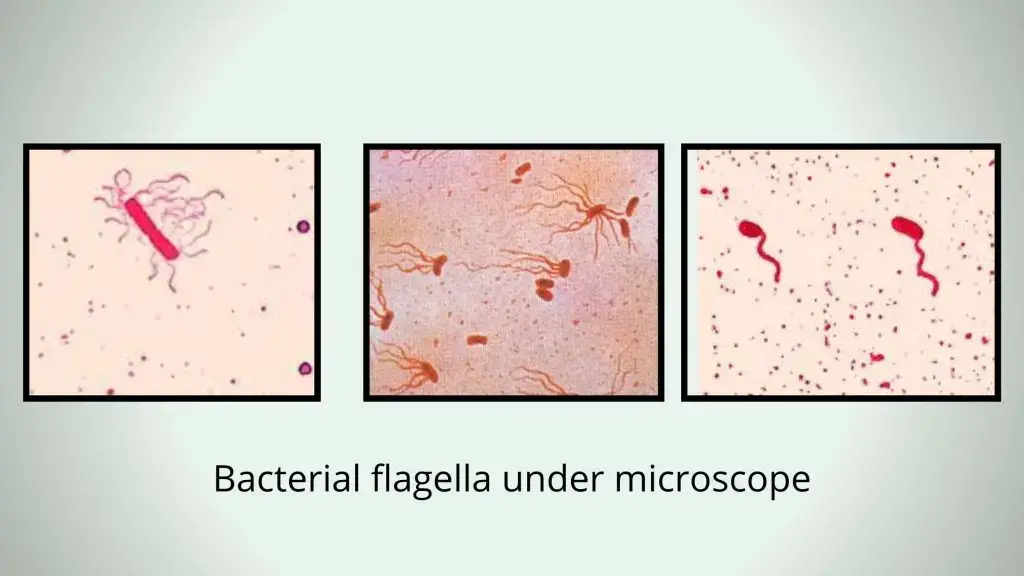
The result of flagella staining is recorded by observing the stained cells under the microscope, and the following points are noted–
- Presence or absence of flagella in the cell.
- Number of flagella present in each bacterial cell.
- Location of flagella per cell such as polar, lophotrichous, or peritrichous arrangement.
- Type of wavelength shown by the flagella, which may be short or long.
- Whether the flagella appear as “tufted” at one or both ends.
- Quality control examples include Peritrichous (Escherichia coli), Polar (Pseudomonas aeruginosa), and Negative (Klebsiella pneumonia).
Uses of Flagella staining
- It is used to detect the presence of flagella in motile bacteria.
- It helps to study the number and arrangement of flagella in bacterial cells.
- It is useful for identifying species where flagellar pattern is an important character.
- It assists in observing motility behaviour of bacteria in wet mount condition.
- It is used in differentiating closely related bacterial groups based on their flagellar distribution.
Advantages of Flagella staining
- It allows clear visualization of very thin flagella which cannot be seen with ordinary stains.
- It helps in determining the number and arrangement of flagella that is essential for identification.
- It is simple to perform using a wet mount preparation.
- It provides important information about bacterial motility structure.
- It can differentiate motile and non-motile bacterial cells effectively.
- Text Highlighting: Select any text in the post content to highlight it
- Text Annotation: Select text and add comments with annotations
- Comment Management: Edit or delete your own comments
- Highlight Management: Remove your own highlights
How to use: Simply select any text in the post content above, and you'll see annotation options. Login here or create an account to get started.